
Garage Sale Pricing: What to Charge for Almost Everything
Price garage sale items with the 10-30% rule: category cheat sheet by item type, verified city permit fees, and signs that pull cars over.
ARTICLE LANGUAGE
Showing original language
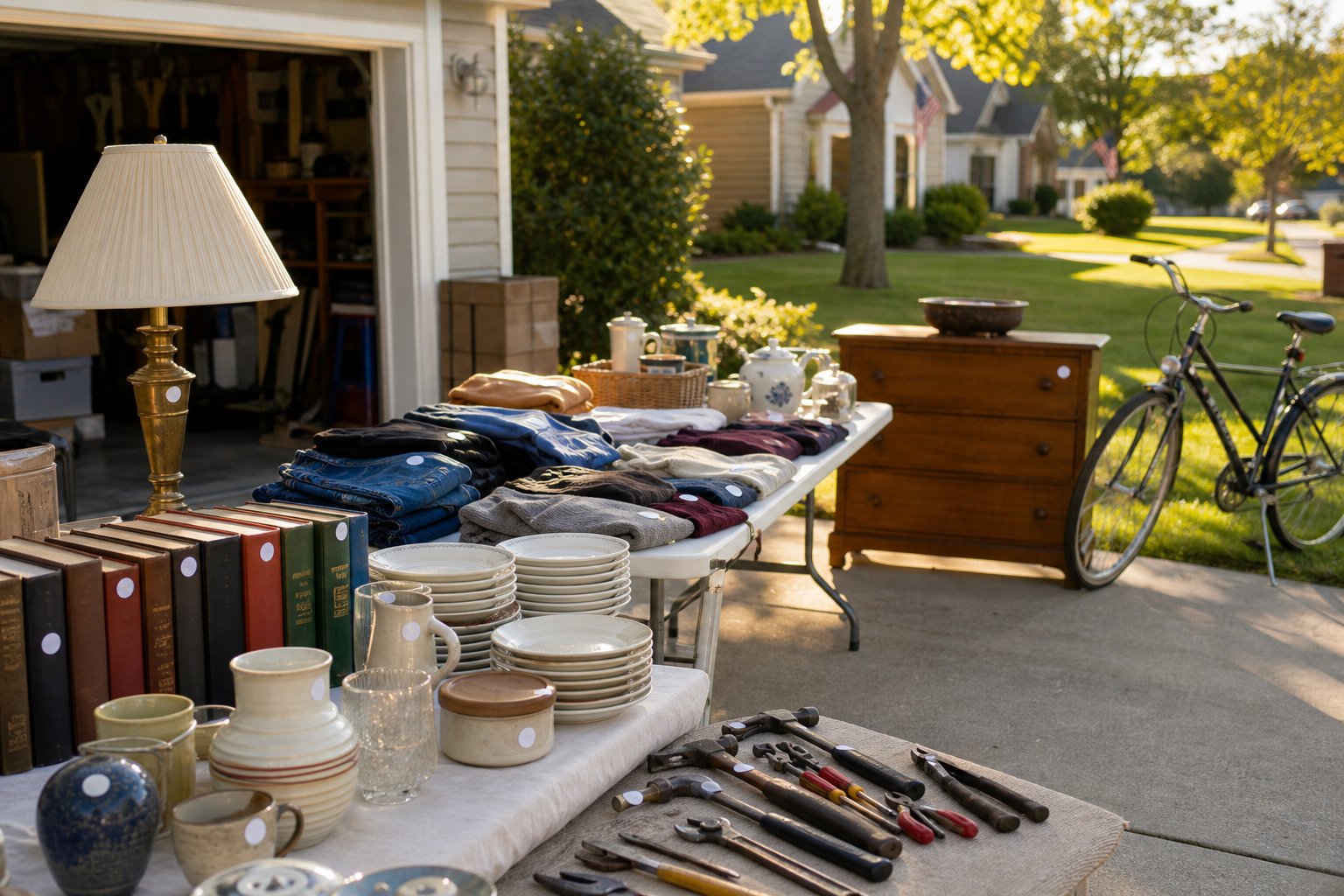
Price most garage sale items at 10–30% of what they cost new. That one rule settles most of your pricing decisions — the rest is knowing which categories run above or below it, how condition shifts the number, and which items are worth too much for a folding table. Below: the category cheat sheet, verified permit rules for major cities, signs that pull cars over, and the move that can double what your biggest items earn. To price a whole garage in minutes, the free garage sale pricing calculator runs these numbers per item and prints signs and sticker sheets — no signup.
The 10–30% rule, and how condition changes it
The formula: garage sale price = original retail × category percentage × condition factor, rounded to a coin-friendly number like 25¢, 50¢, $1, or $5. The category percentages come from established pricing guides such as Angi's garage sale pricing guide (angi.com) and The Dollar Stretcher (thedollarstretcher.com): clothing sits near the bottom at 5–15%, furniture in the middle at 20–30%, and tools at the top at 30–50%, because tools hold value better than almost anything else on a driveway.
Condition moves the number from there. Like-new or in-box items earn about 25% above the category range. Fair condition with visible wear cuts roughly 35% off. Well-worn items lose about 60%. And everything caps at 50% of retail — the realistic garage-sale ceiling, no matter how nice the item is.
Worked example: pricing a $200 coffee table
Say you paid $200 for a coffee table five years ago and it's in good, clean condition. Furniture prices at 20–30% of retail, and good condition keeps the full range: $40–$60. Round to the middle and sticker it at $50. The whole calculation takes ten seconds once you know the category range — which is what the table below is for.
What to charge, category by category
These are typical US ranges synthesized from the pricing guides above — starting points, not appraisals. Low-value categories like books, kids' clothing, and toys skip percentages entirely: they sell at flat prices, because that's how buyers actually shop a table.
| Item type | % of retail | Typical price |
|---|---|---|
| Adult clothing | 5–15% | $1–$5 per piece · coats $5–$15 |
| Kids' clothing | Flat price | $0.50–$3 per piece |
| Shoes | 10–25% | $3–$10 per pair |
| Books | Flat price | Paperbacks $0.50–$1 · hardcovers $1–$3 |
| CDs, DVDs & video games | Flat price | CDs/DVDs $1–$3 · video games $5–$20 |
| Furniture | 20–30% | Sofas $50–$150 · dressers $30–$100 |
| Tools (hand & power) | 30–50% | Hand tools $5–$25 · power tools $10–$50 |
| Kitchen items & dishes | Flat price | $0.50–$5 · complete sets more |
| Small appliances | 20–30% | $5–$25 working |
| Large appliances | 20–30% | $75–$250 working |
| Electronics (TVs, audio, consoles) | 10–25% | TVs $20–$100 · speakers $5–$40 |
| Toys & games | Flat price | $0.25–$3 · ride-ons $5–$20 |
| Baby gear | 10–25% | $5–$30 |
| Bikes & sporting goods | 20–40% | Kids' bikes $10–$40 · adult $25–$80 |
| Home décor & knickknacks | Flat price | $0.25–$5 · framed art $2–$25 |
| Costume jewelry | Flat price | $0.50–$3 |
Post the big stuff online first
Here's the move most sellers skip: big-ticket items commonly earn 2–4× more as free local listings than on a card table. That $50 coffee table? A buyer searching specifically for a coffee table will often pay $100–$150. The person who happened to drive past your house pays $40–$60 — and haggles.
So a week ahead, photograph anything that would sticker at $30 or more — furniture, power tools, large appliances, bikes, working TVs — and post it online. Whatever sells never touches a folding table; whatever doesn't goes into the sale at the sticker price you had planned anyway.
The same logic runs in reverse after the sale. Thinking about listing leftovers on eBay or Mercari? Run the numbers through the reseller fee calculator first — platform fees eat a surprising share of low-priced items. And whatever isn't worth anyone's shipping label, give away through the free stuff section instead of hauling it to a donation drop-off.
Garage sale permits: check before you tape up signs
Garage sale rules are set city by city, not by state — and where permits exist, they usually cost $0–$25 and limit you to two to four sales a year. A sample verified against official sources in July 2026: Dallas requires a permit, but the first sale is free ($25 for the second; two sales per 12 months, up to three consecutive days each). San Antonio charges $16 and allows four sales a year, max two consecutive days. Oklahoma City charges $7, allows two sales a year, and restricts hours to 8 a.m.–6 p.m. Wichita licenses by the day: $2.50 per sale day, plus a $1 card fee online. Fort Worth requires applying at least 72 hours ahead.
Houston, Phoenix, and Nashville require no city permit — but all three cap you at two sales per 12-month period anyway. In unincorporated L.A. County, sales are allowed only on designated weekends (the last full weekend of each month is free, no registration), 7 a.m.–6 p.m., with no Friday sales.
Frequency has a tax angle too: the Texas Comptroller (comptroller.texas.gov) treats more than two sales in 12 months as a business that needs a sales-tax permit. Rules change, so confirm with your city hall or code-compliance office before sale day — a fine costs more than any permit.
Signs, stickers, and sale-day mechanics
- Two words, one arrow. "GARAGE SALE" in thick black letters on classic yellow or white, plus a single directional arrow. Drivers get about three seconds at 30 mph — skip the dates and fine print.
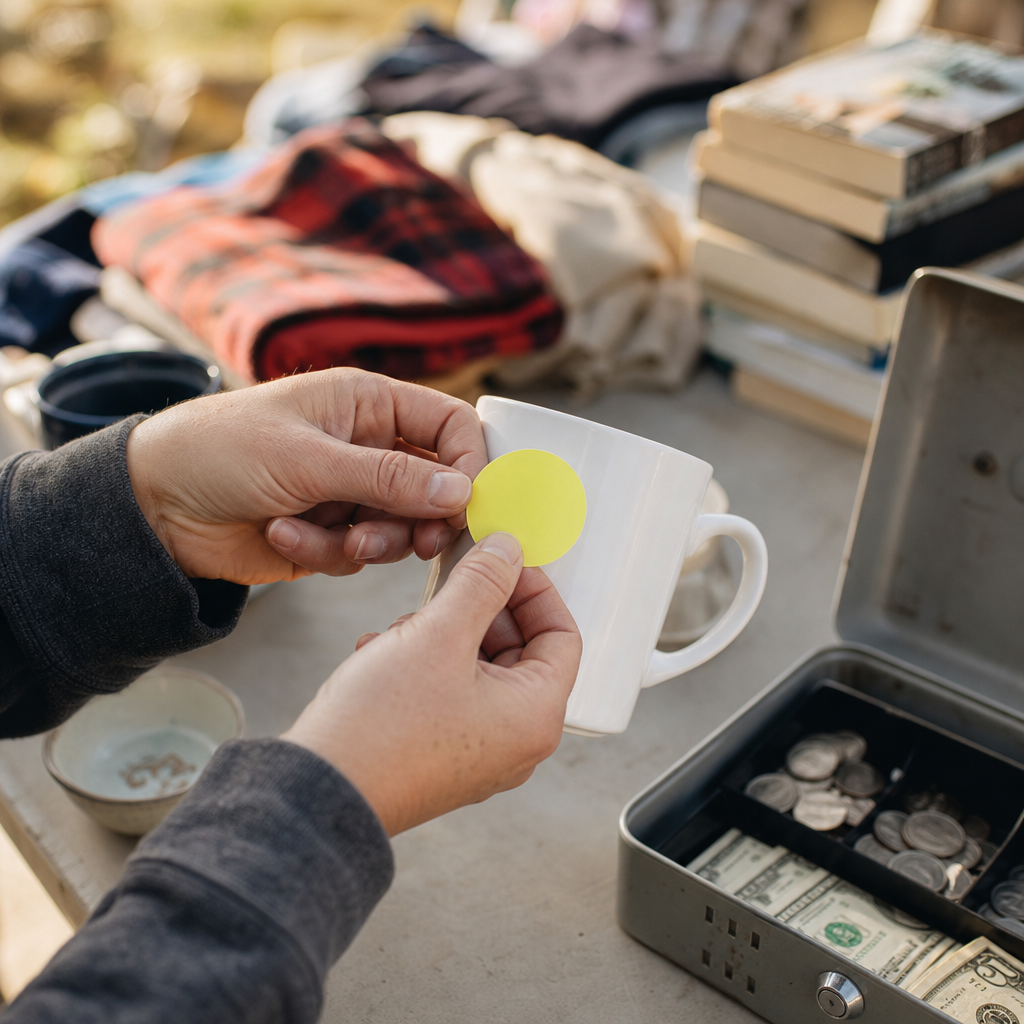
- Sticker every single item. Unpriced items make shoppers walk away instead of asking.
- Use coin-friendly prices. 25¢, 50¢, $1, $5 — round numbers mean faster change and fewer stalled lines. Start the day with $50–$100 in change, mostly $1 bills and quarters.
- Post a "half price after noon" sign for your last day. A blanket 50%-off sign clears leftover inventory without item-by-item haggling.
- Put the big stuff near the street. Furniture, tools, and bikes are what make drive-by traffic stop.
- Take app payments. Tape a Venmo, Cash App, or Zelle QR code to your table — it saves the biggest sales.
Friday and Saturday mornings, roughly 7 a.m. to 2 p.m., are the peak windows. And if you'd rather not hand-letter anything, the pricing calculator also prints bold sale signs with arrows and ready-to-cut price sticker sheets.
Garage sale pricing FAQ
How do you price garage sale items?
Price most items at 10–30% of their original retail price. Clothing runs 5–15%, furniture 20–30%, and tools 30–50%; books, kids' clothes, and toys sell best at flat prices under $3. Adjust for condition and round to coin-friendly numbers like 50¢, $1, or $5.
What is the half-price-after-noon rule?
After 12 p.m. on your final day, cut every price by 50%. Serious shoppers arrive at opening; afternoon traffic is bargain hunters. A posted "half price after noon" sign clears leftover inventory without haggling item by item.
Do I need a permit to hold a garage sale?
Many US cities require one, usually costing $0–$25 and limiting you to 2–4 sales per year. Dallas, San Antonio, Oklahoma City, and Wichita require permits; Houston, Phoenix, and Nashville do not. Check your city hall or code-compliance office before posting signs.
Do I have to pay taxes on garage sale money?
Usually no. Personal items sold for less than you originally paid produce no taxable gain under IRS rules. Frequency can matter, though: in Texas, holding more than two sales in 12 months can require a state sales-tax permit.
What sells best at a garage sale?
Tools, furniture, kids' clothes and toys, kitchen items, and outdoor gear move fastest. Tools hold value best of all, at 30–50% of retail. Big-ticket furniture, appliances, and electronics usually earn 2–4× more posted as free local listings before sale day.
What should you not sell at a garage sale?
Recalled products — reselling them is illegal under federal law, so check cpsc.gov/Recalls before selling cribs, strollers, or toys. Also skip expired or crash-damaged car seats, opened cosmetics, real gold or silver jewelry (get it appraised instead), and anything missing safety parts.



Comments
Loading comments...
Checking sign-in status...