
How to Turn a Weekend Gig Into a Clear Brixaz Listing
Most weekend side hustles stay stuck because the listing is vague. Use this fill-in-the-blank gig template to turn your Saturday skill into real, paid local work.
ARTICLE LANGUAGE
Showing original language
You already have the skill. You can wash cars, haul junk, mow lawns, assemble furniture, hang holiday lights, or move a couch up three flights of stairs. What you probably do not have is a clear way to tell your neighbors that you are available this Saturday and what it will cost them. That gap — not a lack of demand — is why most weekend side hustles stay stuck at "friends and family only."
A gig listing is different from a resume and different from a business page. Nobody reading it wants your life story. They want to know one thing fast: can this person do the specific job I need done, this weekend, for a price I can live with? This guide turns that instinct into a repeatable template you can fill in and post in about ten minutes, so your free time starts converting into real, paid local work.
Why vague gig posts go quiet
The number one mistake in side-work listings is writing an ad about you instead of an ad about the job. "Hard-working and reliable, will do anything, message me" tells the reader nothing they can act on. They cannot picture the task, they cannot guess the price, and they have no reason to believe you over the ten other people who wrote the same sentence.
People hiring for a quick weekend gig are usually solving an annoying, time-sensitive problem: a garage full of stuff before a move, a lawn that got away from them, a flat-pack dresser still in the box. They scan fast and message the first listing that clearly matches. Your job is to be that obvious match. Look at the difference:
| Weak gig post | Gig post that gets messages |
|---|---|
| "Available weekends for odd jobs. Hard worker, fair rates. Hit me up." | "Weekend junk hauling and heavy lifting. I have a pickup truck and moving straps. Load-outs, single-item removal, and small moves. Saturdays and Sundays 8am to 5pm. $60 minimum, most single loads $80-$150 plus dump fee. I text back within an hour." |
The second one is not better writing — it is a better list of facts. Service, equipment, scope, availability, price logic, and response time, all in one glance. That is the whole template, and everything below just fills it in.
The weekend gig listing template

Copy this structure and replace each bracket. Keep the order — a reader on their phone decides in the first two lines whether to keep going.
- Title: [What you do] this weekend in [city or area] — [your edge]. Example: "Furniture assembly this weekend in Mesa — IKEA, cribs, desks, same-day."
- The gig in one line: Say plainly what task you take on. "I assemble flat-pack furniture and mount TVs."
- What is included / not included: Name the common jobs, then one line on what you do not do so you stop getting the wrong messages.
- Equipment you bring: Truck, tools, ladder, dolly, cleaning supplies. This is proof you can actually finish the job.
- Weekend hours: Exact windows. "Saturday 8am-6pm, Sunday 10am-4pm." Vagueness about timing kills weekend gigs specifically.
- Price logic: A minimum plus a range tied to a unit ("$50 minimum, most jobs $50-$120 depending on size"). You are showing how you think about money, not signing a contract.
- Area: Real neighborhoods, zip codes, or "within about 15 miles of [landmark]."
- How to reach you: Tell them exactly what to send so the first message is useful.
Post it under the right category — a weekend hustle usually belongs in gigs, while a recurring skilled trade fits better under local services. Choosing the honest category is not a small detail; it decides who ever sees your post.
Pricing a weekend gig without guessing
"Every job is different" is true, and it is also the reason so many gig workers write "message for price" and then wonder why nobody does. Making the reader do work before they know if you fit their budget is a great way to lose them. The fix is a minimum plus a range with the variable that moves it.
Write it like this: "Yard cleanups start at $60. Most run $60-$140 depending on lawn size and how much debris there is to bag. Send a photo of the yard and I will confirm before I head over." Now a person with a small patch knows they are near the floor, someone with an overgrown quarter-acre knows to expect more, and nobody feels ambushed. You also quietly filter out the person hunting for a $20 favor.
A minimum matters more for gigs than for full services, because it protects your drive time. A 25-minute trip for a $15 task loses you money once gas and the weekend hour are counted. Stating "$50 minimum" up front is not greedy — it is the difference between a hobby and a paid Saturday.
The photo checklist that makes you look legit
For a gig, photos do the trust work that a company name and reviews would do elsewhere. You are proving you are a real person who owns real tools and finishes real jobs. Aim for three to five images:
- A before-and-after of similar work. One honest pair — a cluttered garage next to a cleared one — outsells any amount of description.
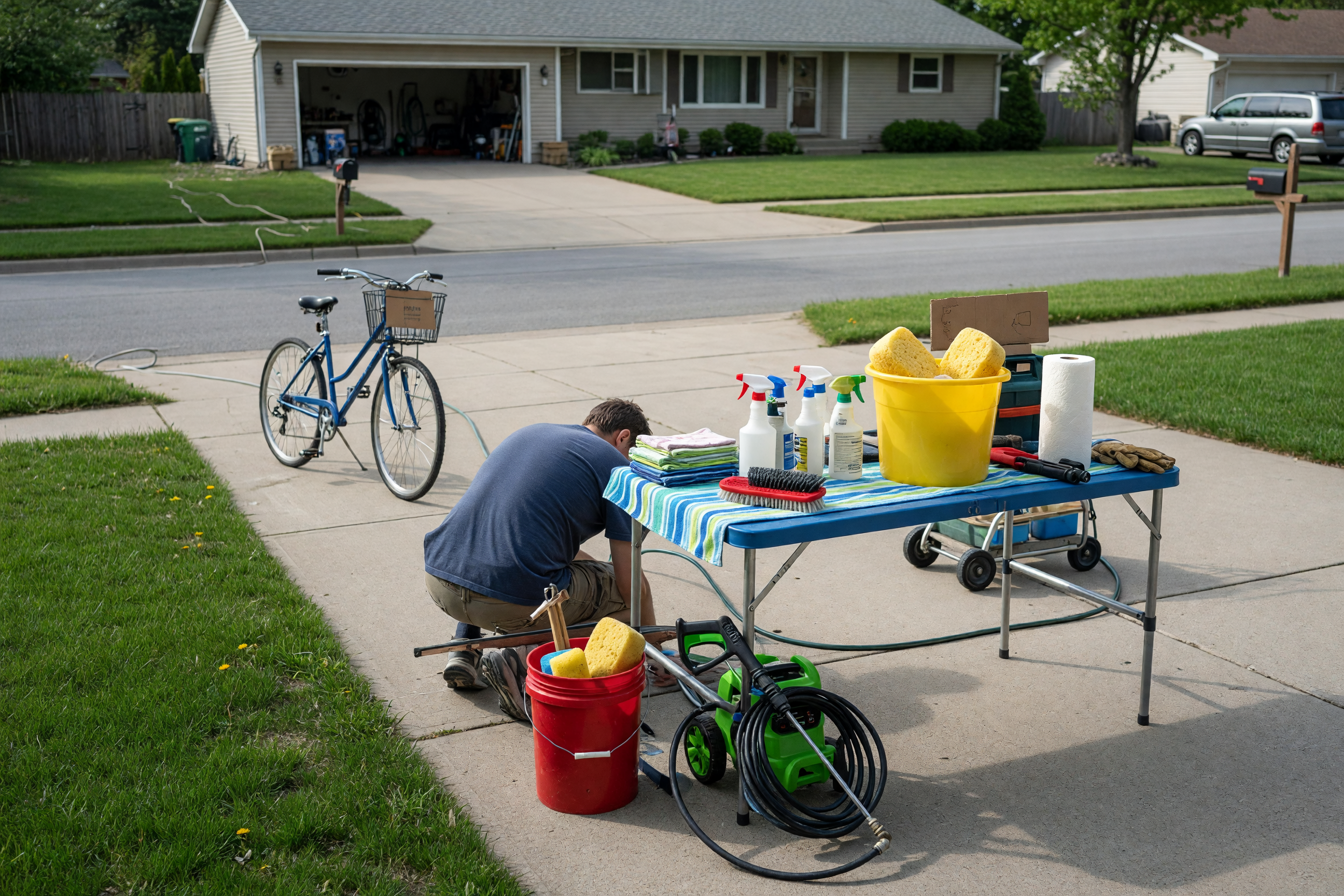
- Your equipment. The truck bed, the tool bag, the pressure washer. It signals you can actually do the task, not just talk about it.
- A finished detail. A level shelf, a bagged pile of debris ready for pickup, a spotless car interior.
- You mid-task, if you are comfortable — it humanizes the post without needing a clear face.
Shoot in daylight, hold the phone steady, and skip the filters. A slightly imperfect real photo beats a glossy image that looks borrowed from a stranger's website every time.
Make the first message do the work
Weekend gigs live and die on speed, because the person messaging you wants it handled before Monday. The fastest way to lose them is a three-day back-and-forth just to learn the basics. End your listing by telling the reader exactly what to include:
- The task, in one line
- Their neighborhood or zip code
- A photo, if the job is visual
- Which day and rough time they want it done
For example: "Message me with the job, your area, a photo, and whether you want Saturday or Sunday, and I will reply with a price and a time." That single sentence can cut your reply time in half, because you stop asking the same four questions on every thread — and on a busy weekend, the person who answers first with a real number usually wins the job.
Where the Brixaz approach changes the outcome
One thing that quietly decides whether a gig listing converts is how the buyer reaches you. On Brixaz, interested people contact you directly instead of routing through a bidding system that pits you against ten strangers racing to the bottom on price. For weekend work that matters a lot: you are not underbidding for scraps, you are having a one-to-one conversation where being specific and a little selective works in your favor.
It also means your category and location choices carry real weight. Posting in the correct gigs section and naming your real city puts you in front of people already searching their own town — you can browse the full list of cities to confirm yours is covered. A clean category and an honest area do more for discovery than any amount of keyword stuffing, because Brixaz is built around local, in-person work rather than anonymous nationwide reach.
A safety boundary worth keeping
Clear listings also protect you. State your terms in the post so there is no awkward negotiation on the doorstep: a minimum, whether you need access to water, power, or a parking spot, and that the price is confirmed by message before you head out. For first-time clients, it is reasonable to meet in daylight, keep someone informed of where you are going, take payment on completion rather than fully up front, and trust your gut if a request feels off. Setting these expectations in the listing reads as professional, not paranoid — and it quietly screens out the rare person who was never a good fit.
Related: weekend gig listing template
Related: weekend gig listing template
Related: weekend gig listing template
Related: weekend gig listing template
Frequently asked questions
Should I put a price on a weekend gig or wait to be asked?
Put a minimum and a range. A weekend buyer wants to know instantly whether you fit their budget, and "message for price" makes them do work before they know that. A minimum plus a range tied to job size lets people self-qualify and protects your drive time on smaller jobs.
What is the difference between posting in gigs versus local services?
Gigs suit one-off or weekend side work — hauling, a single move, a yard cleanup, furniture assembly. Local services suit an ongoing, recurring offer you treat like a small business. Pick the category that honestly matches, because it decides who sees your post and what they expect when they message.
How many photos does a gig listing need?
Three to five. Lead with a before-and-after of similar work, add a shot of your equipment, and include one finished-detail close-up. Real daylight photos of your own work build more trust than any words, especially when you have no reviews yet.
I have never done this for money before. Can I still post?
Yes. Photograph work you have done for yourself, friends, or family with permission, be upfront that you are getting started, and compete on clear pricing and fast replies. Plenty of people happily hire a careful newcomer who communicates well over a vague veteran who takes a day to answer.
How fast do I really need to respond?
On weekends, very fast. Most people message more than one person and hire whoever replies first with a real price and time. Even a quick "Got it — I can do Saturday afternoon, sending a price now" holds the lead while you look at their photo and confirm.





Comments
Loading comments...
Checking sign-in status...